Source files: sources/21-benchmarks/frontier-lab-eval-sdk-crosswalk-2026-raw.md · sources/21-benchmarks/frontier-lab-eval-sdk-primary-sources-2026.md · sources/21-benchmarks/frontier-lab-eval-sdk-primary-sources-2026.jsonl · sources/21-benchmarks/frontier-lab-eval-type-matrix-2026.json · sources/21-benchmarks/frontier-lab-eval-sdk-primary-sources/raw/ · research/21-benchmarks/raw/frontier-lab-eval-sdk-*.pdf · research/21-benchmarks/raw/frontier-lab-eval-sdk-*.chandra.txt · research/21-benchmarks/enterprise-evaluation-knowledge-coding-agents-2026.md · research/21-benchmarks/decentralized-gitlab-eval-federation-2026.md · docs/research-synthesis-verification-loop.md
See also: Enterprise Evaluation for Knowledge Bases and Coding Agents · Decentralized GitLab Eval Federation · Benchmark Foundations · Agent Observability Format Standard
Source status: This report synthesizes primary lab documentation, SDK references, model-card benchmark disclosures, and eval papers retrieved on June 21, 2026. The primary-source ingestion inventory captures 43 source rows with local raw mirrors or fallback raw repository/current-doc captures; PDF-backed papers are stored under
research/21-benchmarks/raw/with Chandra text extraction where available. It distinguishes implementation primitives from measured effectiveness. Vendor/lab docs are treated as capability evidence; model cards are treated as benchmark disclosures; papers are treated as method evidence. None of these replace private enterprise eval packs.
Executive Summary
Frontier labs are converging on the same evaluation thesis: the evaluated unit is no longer only the model; it is the model plus tools, context, policies, traces, and task state. The SDK primitive layer is becoming as important as benchmark scores.
The overlap is clear:
- Task datasets and private golden sets appear in OpenAI Evals, Anthropic Console evals, Google Gen AI Evaluation, LangSmith/DeepEval/RAGAS-style workflows, and enterprise benchmark-pack practice.
- Rubrics and LLM judges appear in OpenAI graders, Anthropic prompt-quality grading, Google adaptive/rubric metrics, ADK final-response metrics, DeepMind FACTS judges, and TencentLLMEval human/LLM evaluation processes.
- Trajectory and tool-use evaluation appears in Google ADK, OpenAI Agents traces, Anthropic Agent SDK hooks/subagents/MCP, Microsoft AutoGen teams, Mistral Agents and function calling, Qwen-Agent, and Bedrock Agents.
- Groundedness and knowledge-base evaluation appears in Google FACTS Grounding/SAFE, Bedrock Knowledge Bases, Mistral citations/document libraries, Cohere search/rerank, RAGAS, and enterprise KB eval stacks.
- Interoperability evaluation is emerging from A2A and MCP. These are not eval frameworks, but they define observable contracts: capability discovery, authorization, task lifecycle, resources, tools, sampling, artifacts, and consent.
The divergence is equally important:
- OpenAI, Google, Anthropic, Microsoft, AWS, Mistral, and Meta Llama Stack expose eval or agent/runtime primitives that can be instrumented directly. Meta is stronger on eval/scoring/RAG benchmark infrastructure than a model-card-only reading would imply, but still less explicit on app-agent trajectory evaluation than Google ADK or Anthropic/OpenAI agent SDKs.
- DeepSeek, Moonshot/Kimi, Z.ai, Tencent, ByteDance Seed, Baidu, InternLM, 01.AI, Baichuan, StepFun, and MiniMax often expose model cards, benchmarks, OpenAI-compatible APIs, or deployment toolkits, but less first-party eval operating-system infrastructure. They should be evaluated through the enterprise harness rather than trusted through vendor-native eval surfaces.
- Qwen is the main Chinese open-weight exception because Qwen-Agent and Qwen function-calling docs provide a concrete local agent/tool/RAG harness surface.
- NVIDIA is not a frontier model lab in the same sense here; its evaluation contribution is the security/guardrail lane through garak and NeMo Guardrails.
The operating recommendation is to standardize the enterprise eval result contract, not the lab SDK. Each lab SDK can run locally in a repo or platform environment, but every run should emit the same normalized result row: model, harness, SDK primitive, task, trace, source bundle, judge, score, failure code, and artifact references.
Cross-Lab Concept Matrix
| Lab / platform | Main eval concepts | SDK/runtime primitives | Best enterprise eval use | Boundary |
|---|---|---|---|---|
| OpenAI | Evals as BDD-like task specs; graders; private evals; trace-to-improvement loops | Evals API, OpenAI Evals, Agents SDK traces, tools, handoffs, guardrails, MCP/connectors, Codex/CUA surfaces | Portable task/JSONL/grader pattern and trace-backed agent regression | Strong eval API, but private enterprise correctness still needs local goldens and exported evidence |
| Anthropic | Prompt evals, generated/manual/CSV test cases, side-by-side comparisons, quality grades; agent skills and MCP as procedural/context primitives | Claude Console evals, Agent SDK, Claude Code loop, hooks, permissions, subagents, sessions, MCP, skills, OpenTelemetry | Coding-agent and skills evals with hooks, permission boundaries, tool traces, and procedural-knowledge tests | Console evals are prompt-centric; enterprise needs warehouse export and deterministic checks |
| Google / DeepMind | Adaptive/rubric metrics; ADK trajectory vs final response; FACTS factuality lanes; SAFE atomic-claim verification; A2A interop | Gen AI Evaluation Service, ADK eval sets, Agent Platform, A2A Agent Cards/tasks/artifacts, Gemini grounding tools | Agent trajectory eval, factuality decomposition, A2A interop checks, KB groundedness | A2A is interop, not scoring; FACTS is benchmark methodology, not a corporate KB harness |
| Meta | Llama Stack eval APIs, scoring providers, RAG benchmark examples, public benchmark/model-card disclosure | Llama Stack eval references, benchmark/scoring CLI templates, RAG benchmarks, Llama model releases, safety/model cards | Open-weight model regression, self-hosted eval services, RAG benchmark runs | Stronger eval substrate than model cards alone; less explicit on app-agent trajectory scoring than Google ADK or Anthropic/OpenAI agent SDKs |
| Microsoft | Multi-agent architecture evaluation, AutoGenBench, team stop conditions, trace/observability, Foundry monitoring | AutoGen AgentChat/Core/Studio, teams, Magentic-One, GraphFlow, Swarm, Azure AI Foundry eval/observability | Multi-agent architecture comparison and enterprise cloud governance | AutoGen evaluates systems; model effectiveness depends on backend and task harness |
| AWS / Amazon | Managed agents, KBs, action groups, versions/aliases, traces, ACL-aware retrieval, citations, agentic retrieval | Bedrock Agents, Knowledge Bases, AgentCore Gateway/Observability, action groups, aliases, managed connectors | Enterprise KB/RAG and action-agent evals under cloud governance | Managed service docs do not certify retrieval quality on each corporate corpus |
| NVIDIA | Security probing, adversarial testing, programmable rails, guardrail robustness | garak probes/generators/detectors/reports, NeMo Guardrails rails | Security eval lane: prompt injection, jailbreak, unsafe output, guardrail bypass | Security tools find vulnerabilities; they do not replace domain correctness evals |
| Mistral | Agent handoffs, persistent conversations, connector tools, citations, function/tool calling | Agents and Conversations API, handoffs, web search, code interpreter, document library, MCP connectors, structured outputs | European/open-model agent runtime lane; evaluate handoff, citation, state, tool schemas | Public docs expose runtime primitives more than eval methodology |
| Cohere | Search/rerank-first enterprise AI, agentic chat/tooling, retrieval quality | Agents/tool use, Embed/Rerank, connectors/search APIs | Retrieval, reranking, semantic search, enterprise KB grounding | Eval primitives are mostly retrieval/app-centric, not broad agent eval science |
| AI21 | Enterprise model/API and workflow surface | Maestro/workflow-style API surfaces | External model candidate lane and workflow evaluation through local harness | Public eval-specific primitive coverage is thinner |
| xAI | Model/API access and tool/function surfaces | OpenAI-compatible API style, Grok model access | External frontier model candidate through private eval harness | Limited public eval tooling; treat benchmark claims as candidate evidence |
| Alibaba Qwen | Function calling, think/no-think modes, Qwen-Agent, MCP/code/RAG local harness, open benchmark disclosure | Qwen-Agent, OpenAI-compatible serving, vLLM, function-call templates, MCP, code interpreter, RAG | Best Chinese/open-weight local agent/tool eval surface | Tool performance is template/runtime-sensitive; evaluate exact serving stack |
| DeepSeek | Reasoning/RL benchmark disclosure, OpenAI-compatible function calling | DeepSeek API function calling, open models, OpenAI-compatible clients | Reasoning and tool-call candidate evaluated by enterprise harness | Strong benchmark visibility, limited first-party eval operating system |
| Moonshot / Kimi | Agentic data synthesis, joint RL, coding and agentic benchmark scores | Kimi/K2 OpenAI-compatible APIs and open-weight models | Coding-agent and long-horizon tool-use candidate | Strong model-card benchmark claims; safety and enterprise evals must be external |
| Z.ai / GLM | Open model benchmark disclosure, coding/reasoning/agentic positioning | GLM open models, API/chat surfaces, AutoGLM product lineage | Open-weight Chinese model candidate and mobile/agent task eval lane | Eval through external harness; first-party SDK/eval docs are not as central |
| Tencent / Hunyuan | TencentLLMEval hierarchical human-alignment task tree; Hunyuan benchmark reporting | Hunyuan model/API ecosystem | Taxonomy source for bilingual human-alignment evals | TencentLLMEval is strong methodology but not the same as SDK-native eval telemetry |
| ByteDance Seed | Real-world agency, search/code/GUI interface, agentic benchmark reporting | Seed model/API surfaces | GUI/search/code agent benchmark candidate | Model-card evidence; eval harness must capture external task traces |
| Baidu ERNIE | Knowledge-enhanced pretraining, ERNIE 4.5 open toolkit, function-call training support, Chinese KB/model lineage | ERNIE/PaddlePaddle models, ERNIEKit, FastDeploy, training/compression/inference workflow, knowledge-retrieval cookbook | Chinese knowledge-base, multimodal, function-call, and knowledge-enhanced model lane | Eval remains benchmark/model-toolkit evidence; Qianfan/Wenxin managed-agent eval primitives need separate capture |
| InternLM / Shanghai AI Lab | Open model/deployment ecosystem | InternLM repository evidence; LMDeploy docs were not fully captured because rendered docs were rate-limited | Local/open model eval and deployment-latency lane | Treat as weaker source coverage until LMDeploy-specific docs are ingested |
| 01.AI / Yi | Model release benchmark disclosure | Yi open model repository/API | Open model candidate lane | No first-class eval SDK in public sources checked |
| Baichuan | Model release benchmark disclosure | Baichuan open model repository/API | Chinese model candidate lane | No first-class eval SDK in public sources checked |
| StepFun | Model/API platform | Step API/model surfaces | External model candidate lane | Eval docs and agent primitives require follow-up source acquisition |
| MiniMax | Model/API platform; current docs include model overview and navigation for MCP-related docs | MiniMax API/model surfaces | External model candidate lane | The legacy docs URL moved; captured current models page, but eval and agent primitives still require deeper source acquisition |
Post-Ingestion Delta
The deeper ingestion does not change the core finding: enterprises should standardize result records and source/trace contracts rather than standardizing on one lab SDK. It does change four details:
- Meta is stronger than the first-pass synthesis implied. The Llama Stack repository includes explicit eval references, scoring providers, CLI eval templates, and RAG benchmark examples. Meta should sit in the “self-hosted eval substrate” lane, not only the “model-card disclosure” lane.
- Baidu is stronger on current open-tooling than the older ERNIE 3.0 paper alone showed. The ERNIE repository now exposes ERNIE 4.5, ERNIEKit, FastDeploy, function-call training support, and a knowledge-retrieval cookbook. That strengthens Baidu as a Chinese KB/function-call/model-toolkit lane, while still not making it a first-party eval operating system.
- InternLM coverage is weaker than the first-pass wording implied. The rendered ReadTheDocs source was rate-limited and the fallback artifact is the InternLM repository README, not a full LMDeploy/agent/eval docs ingestion. Keep InternLM as an external harness lane until LMDeploy-specific sources are captured.
- MiniMax should be treated as a moved-docs/API-model lane, not an eval lane. The old
/platform/documentURL 404s; the current docs URL captured a model overview page and navigation that includes MCP, but not a first-class eval primitive.
Visual Readout
The matrix below is a capability-evidence map, not a leaderboard. Scores are derived from the ingested primary-source corpus:
0means no relevant support was captured in the ingested public sources.1means candidate evidence, model-card evidence, or benchmark disclosure.2means an instrumentable runtime, SDK, API, or toolkit primitive.3means an explicit eval framework, eval service, benchmark method, or first-party evaluation workflow.
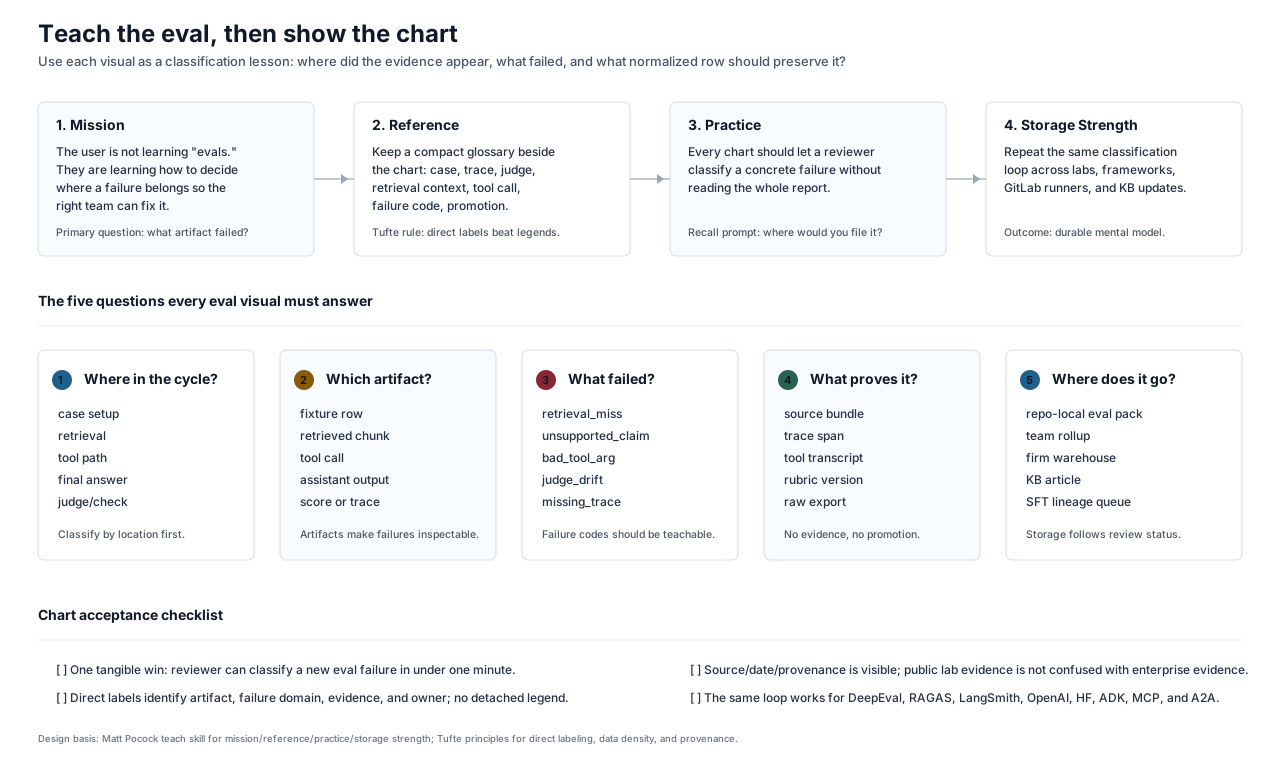
The Teach-informed reading order is: mission, reference, practice, retention. The mission is not to memorize vendor names. The mission is to classify a failure quickly enough that the right owner can fix it and the right artifact can preserve it. Every visual should therefore answer five questions before it compares labs:
- Where in the agentic chat cycle did the evidence appear?
- Which artifact failed: fixture, retrieval context, tool call, final answer, judge record, trace, or promotion record?
- Which failure code should the user apply?
- What raw evidence proves the classification?
- Where should the result live: repo-local pack, team rollup, firm warehouse, KB article, or training lineage queue?
This also keeps the Tufte bar high: direct labels beat legends, source/date/provenance must be visible, and the chart has to carry a real classification task rather than merely decorating the report.
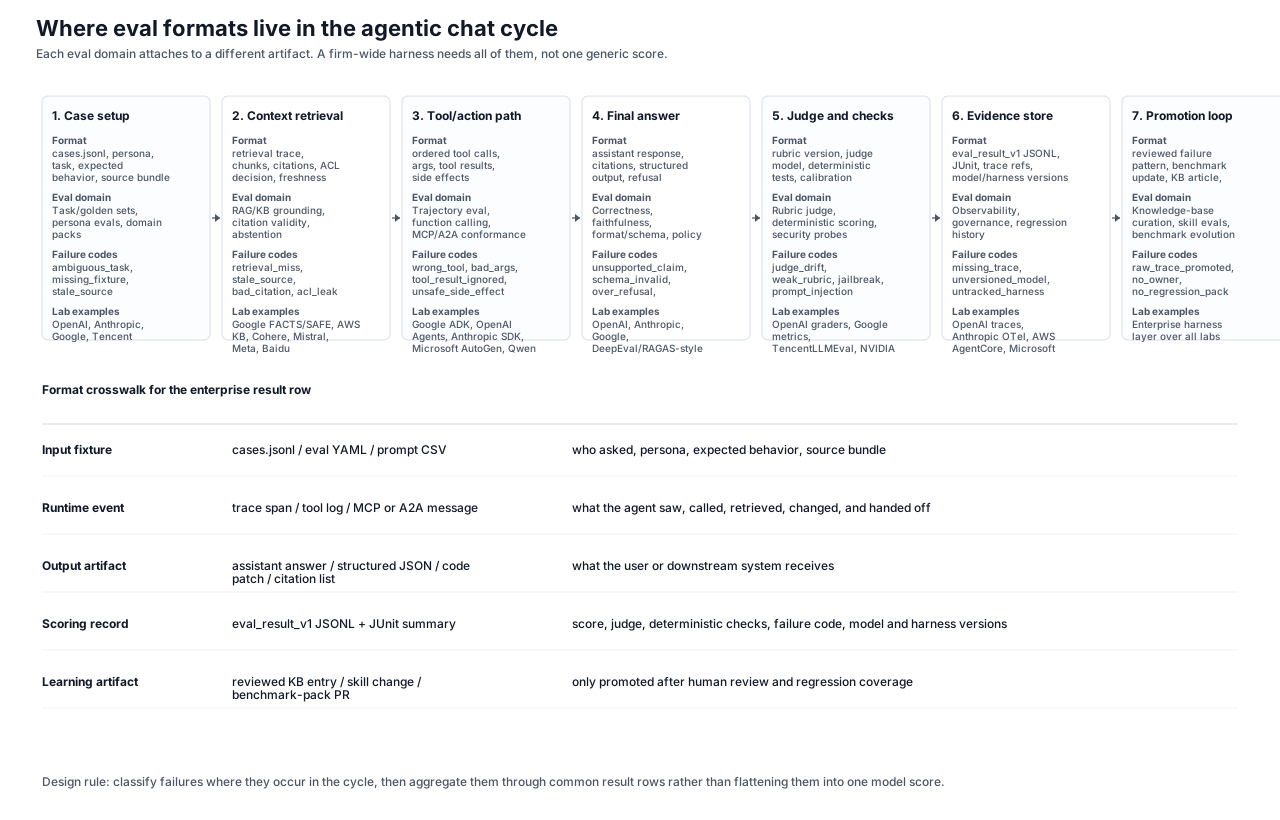
The most useful teaching frame is not “which lab wins.” It is where the eval lives:
- Case setup: task fixtures, personas, expected behavior, and source bundles live before the first model call.
- Context retrieval: retrieval traces, chunks, citations, ACL decisions, and freshness checks live between user intent and model context.
- Tool/action path: tool calls, arguments, results, handoffs, MCP/A2A messages, and side effects live in the trajectory.
- Final answer: structured output, citations, refusal behavior, and user-facing text live at response time.
- Judge/check layer: rubric judges, deterministic checks, calibration records, and security probes live after the run.
- Evidence store:
eval_result_v1, JUnit, trace references, model versions, and harness versions live in CI artifacts and the eval warehouse. - Promotion loop: only reviewed failures, benchmark updates, KB entries, and skill changes should be promoted back into durable knowledge.
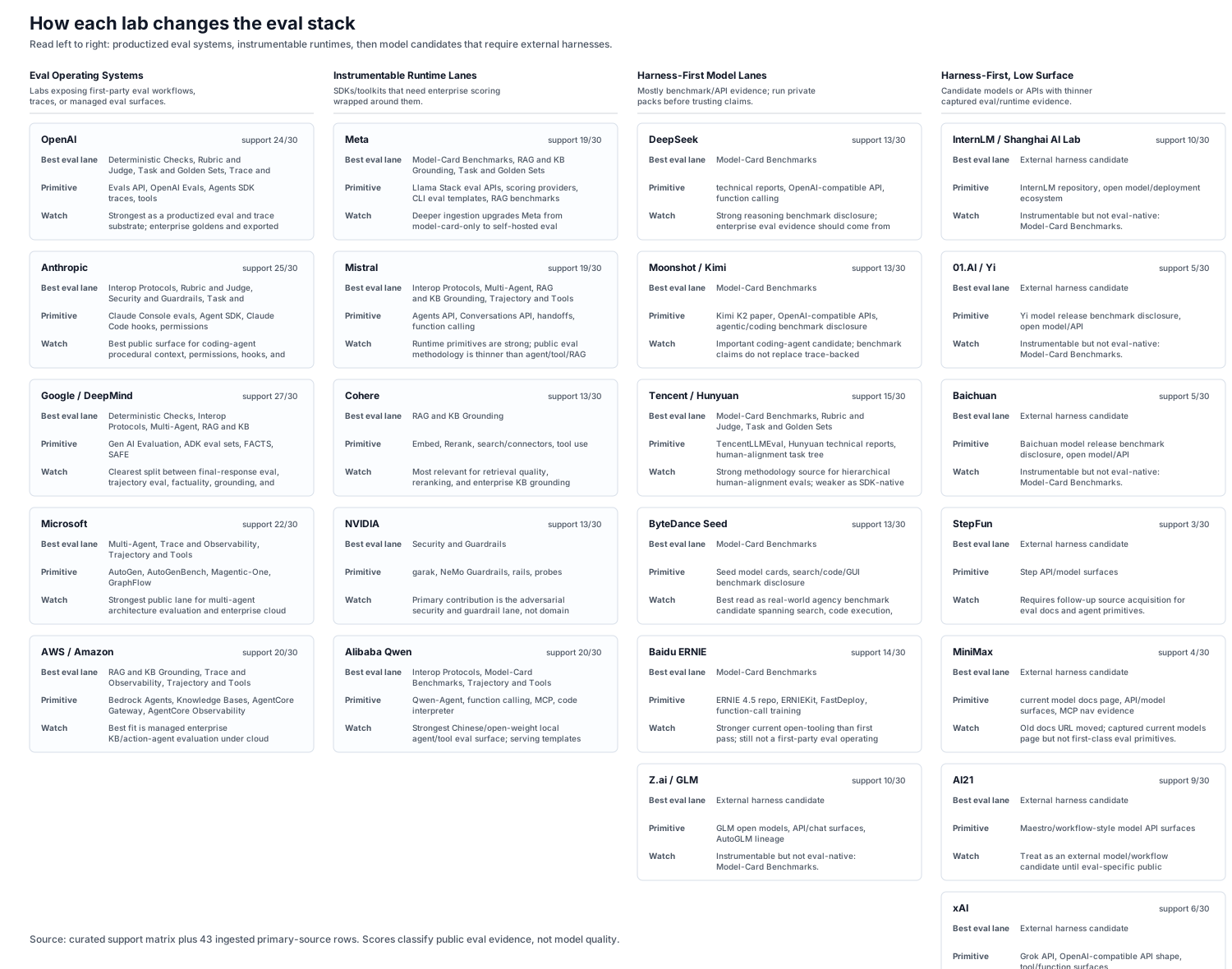
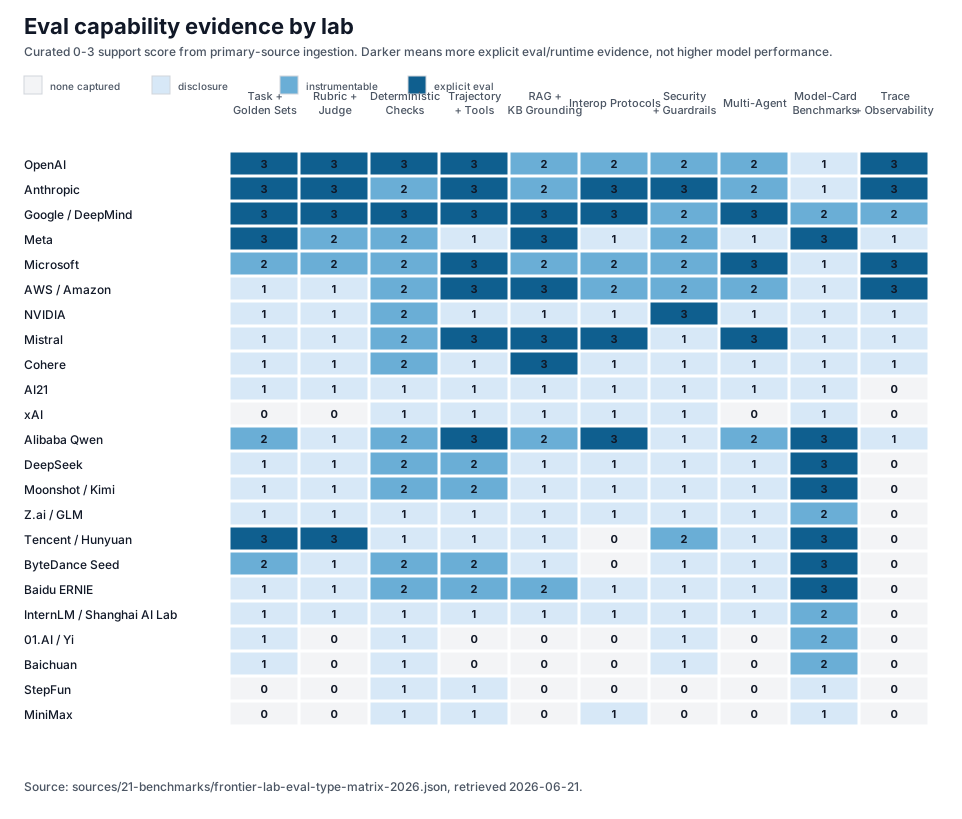
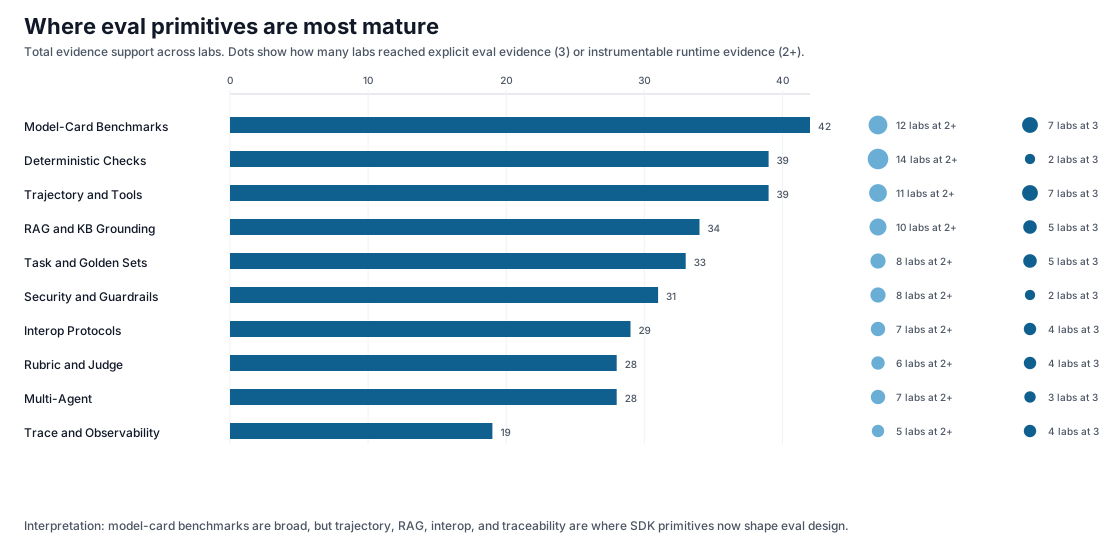
The broadest evidence category is still model-card benchmark disclosure. That should not be mistaken for deployable enterprise evidence. The operational center of gravity is moving toward trajectory/tool evaluation, RAG and KB grounding, interop contracts, and trace observability because those are the parts that make an agent system auditable.
Eval Type Deep Dive
| Eval type | What it measures | Strongest lab/source families | SDK primitives that matter | Enterprise harness implication | Main divergence |
|---|---|---|---|---|---|
| Task and golden-set evals | Whether a model or agent solves repeatable cases with expected answers, expected behaviors, or known grading criteria | OpenAI Evals, Anthropic Console evals, Google Gen AI Evaluation, TencentLLMEval, Meta Llama Stack eval examples | Eval APIs, JSONL/CSV cases, dataset manifests, local harness adapters | Store private eval packs in each repo, version cases and expected outputs, and emit normalized result rows | Western/cloud labs expose product workflows; many Chinese labs expose benchmark tables but not enterprise-ready case runners |
| Rubric and judge evals | Quality against subjective or decomposed criteria where exact answers are insufficient | OpenAI graders, Anthropic quality grading, Google adaptive/rubric metrics, FACTS/SAFE, TencentLLMEval | Judge model, rubric version, calibration set, disagreement tracking | Record judge identity and rubric version as first-class fields; keep calibration disagreements as artifacts | Some labs present judge-backed methods; others publish benchmark scores without reusable rubrics |
| Deterministic checks | Programmatic pass/fail for schemas, citations, code tests, ACLs, exact answers, and protocol contracts | OpenAI/Google eval templates, Qwen/DeepSeek function calling, MCP/A2A conformance surfaces, CI-style StateBench checks | JSON schema, unit tests, citation span validators, tool argument validators, protocol conformance tests | Prefer deterministic checks whenever possible because they are cheaper, auditable, and stable under judge drift | Agent runtime docs often expose enough events to validate deterministically even when the vendor does not call it an eval |
| Trajectory and tool evals | Whether the system chose the right tools, arguments, retries, handoffs, permissions, and stopping conditions | Google ADK, OpenAI Agents traces, Anthropic hooks/subagents, Microsoft AutoGen, AWS Bedrock traces, Mistral handoffs, Qwen-Agent | Trace APIs, tool call logs, action groups, handoffs, sessions, hooks, spans | Score path and answer separately; failed trajectories should classify as tool selection, bad args, missing tool result use, permission issue, or side-effect issue | Google names trajectory eval most explicitly; others expose enough runtime state to implement it externally |
| RAG and KB grounding | Retrieval quality, source authority, citation span validity, claim support, freshness, and abstention | Google FACTS/SAFE, AWS Bedrock Knowledge Bases, Mistral document libraries/citations, Cohere Embed/Rerank, Meta RAG benchmarks, Baidu knowledge retrieval | Retrieval traces, citation APIs, document libraries, rerankers, source manifests | Split “RAG accuracy” into retrieval hit, source quality, grounded claim support, answer utility, and abstention | Search/retrieval vendors emphasize retrieval quality; agent SDK vendors emphasize traceability; model-card labs rarely establish private-corpus grounding |
| Interop protocol evals | Whether agents/tools/resources truthfully advertise capabilities and preserve task/artifact lifecycle contracts | Anthropic MCP, Google A2A, Mistral MCP connectors, Qwen-Agent MCP, AWS AgentCore Gateway, OpenAI connectors/MCP surfaces | Agent Cards, MCP tools/resources/prompts, task lifecycle, artifacts, auth, roots, consent, cancellation | Add conformance packs for MCP resource ACLs, tool authorization, prompt-injection boundaries, A2A task lifecycle, and artifact integrity | Standards define observable contracts, not answer quality; enterprises must add scoring and governance on top |
| Security and guardrail evals | Resistance to jailbreaks, prompt injection, unsafe output, tool abuse, data leaks, and policy bypass | NVIDIA garak/NeMo Guardrails, Anthropic permissions/MCP guidance, OpenAI/Google safety lanes, Bedrock governance | Probes, detectors, guardrail policies, permissions, sandboxing, audit logs | Run adversarial packs separately from domain correctness; failure categories should include prompt injection, excessive privilege, unsafe tool use, and policy bypass | NVIDIA contributes the deepest tool lane while most model labs blend safety into model/system cards |
| Multi-agent evals | Coordination quality, role adherence, handoff correctness, stop conditions, variance, cost, and failure propagation | Microsoft AutoGen/AutoGenBench, Google A2A, Mistral handoffs, OpenAI handoffs, Anthropic subagents, Qwen-Agent multi-agent examples | Teams, handoffs, agent cards, subagents, state graphs, stop reasons, conversation/session records | Persist architecture ID, agent roles, handoff count, stop reason, run variance, and per-agent traces | Microsoft is strongest on architecture evaluation; Google is strongest on interop lifecycle; others expose runtime hooks without equivalent benchmark depth |
| Model-card benchmark evals | Lab-reported benchmark scores and candidate capability evidence | Meta, DeepSeek, Kimi, Z.ai, Tencent, ByteDance, Baidu, InternLM, 01.AI, Baichuan, StepFun, MiniMax | Model cards, technical reports, leaderboards, API compatibility, local serving | Use as shortlist input only; rerun private task packs before procurement, deployment, or KB promotion | This is the broadest evidence type but the weakest for enterprise claims because tasks, prompts, serving templates, and contamination controls differ |
| Trace and observability evals | Whether an eval run produces enough spans, logs, and artifacts to audit behavior and regressions | OpenAI Agents traces, Anthropic Agent SDK/OpenTelemetry, Microsoft Foundry/AutoGen, AWS AgentCore Observability, Google ADK/Agent Platform | Trace IDs, spans, OpenTelemetry export, token/cost usage, tool events, guardrail events, source bundle refs | Make trace completeness a gate before judging quality; a high score without trace coverage is not governance-grade evidence | Labs disagree on trace schema and export depth, so the enterprise contract needs normalized fields over vendor-native traces |
Lab × Eval-Type Matrix
This table compresses the SVG heatmap into reviewable source text. It should be read with the 0-3 support scale above.
| Lab / platform | Task | Rubric | Deterministic | Trajectory | RAG/KB | Interop | Security | Multi-agent | Model card | Trace |
|---|---|---|---|---|---|---|---|---|---|---|
| OpenAI | 3 | 3 | 3 | 3 | 2 | 2 | 2 | 2 | 1 | 3 |
| Anthropic | 3 | 3 | 2 | 3 | 2 | 3 | 3 | 2 | 1 | 3 |
| Google / DeepMind | 3 | 3 | 3 | 3 | 3 | 3 | 2 | 3 | 2 | 2 |
| Meta | 3 | 2 | 2 | 1 | 3 | 1 | 2 | 1 | 3 | 1 |
| Microsoft | 2 | 2 | 2 | 3 | 2 | 2 | 2 | 3 | 1 | 3 |
| AWS / Amazon | 1 | 1 | 2 | 3 | 3 | 2 | 2 | 2 | 1 | 3 |
| NVIDIA | 1 | 1 | 2 | 1 | 1 | 1 | 3 | 1 | 1 | 1 |
| Mistral | 1 | 1 | 2 | 3 | 3 | 3 | 1 | 3 | 1 | 1 |
| Cohere | 1 | 1 | 2 | 1 | 3 | 1 | 1 | 1 | 1 | 1 |
| AI21 | 1 | 1 | 1 | 1 | 1 | 1 | 1 | 1 | 1 | 0 |
| xAI | 0 | 0 | 1 | 1 | 1 | 1 | 1 | 0 | 1 | 0 |
| Alibaba Qwen | 2 | 1 | 2 | 3 | 2 | 3 | 1 | 2 | 3 | 1 |
| DeepSeek | 1 | 1 | 2 | 2 | 1 | 1 | 1 | 1 | 3 | 0 |
| Moonshot / Kimi | 1 | 1 | 2 | 2 | 1 | 1 | 1 | 1 | 3 | 0 |
| Z.ai / GLM | 1 | 1 | 1 | 1 | 1 | 1 | 1 | 1 | 2 | 0 |
| Tencent / Hunyuan | 3 | 3 | 1 | 1 | 1 | 0 | 2 | 1 | 3 | 0 |
| ByteDance Seed | 2 | 1 | 2 | 2 | 1 | 0 | 1 | 1 | 3 | 0 |
| Baidu ERNIE | 1 | 1 | 2 | 2 | 2 | 1 | 1 | 1 | 3 | 0 |
| InternLM / Shanghai AI Lab | 1 | 1 | 1 | 1 | 1 | 1 | 1 | 1 | 2 | 0 |
| 01.AI / Yi | 1 | 0 | 1 | 0 | 0 | 0 | 1 | 0 | 2 | 0 |
| Baichuan | 1 | 0 | 1 | 0 | 0 | 0 | 1 | 0 | 2 | 0 |
| StepFun | 0 | 0 | 1 | 1 | 0 | 0 | 0 | 0 | 1 | 0 |
| MiniMax | 0 | 0 | 1 | 1 | 0 | 1 | 0 | 0 | 1 | 0 |
Concept Overlap
| Concept | Labs / platforms where it appears | Shared meaning | Enterprise implementation |
|---|---|---|---|
| Private eval dataset / golden set | OpenAI, Anthropic, Google, LangSmith/DeepEval, Tencent methodology | A repeatable set of task cases with expected behavior or scoring criteria | Store as versioned repo-local evals/<pack>/cases.jsonl plus source bundle manifest |
| Rubric-based judging | OpenAI graders, Anthropic quality grades, Google adaptive/rubric metrics, DeepMind FACTS, TencentLLMEval | Judge output against criteria when deterministic scoring is impossible | Record judge model/version, rubric version, calibration sample, and disagreement rate |
| Deterministic scoring | OpenAI Evals templates, Google computation metrics, DeepEval custom metrics, CI tests, code benchmarks | Programmatic pass/fail or numeric score from reference data | Prefer for schema, citations, tool args, code tests, ACLs, and known-answer tasks |
| Trajectory evaluation | Google ADK, OpenAI traces, Anthropic hooks/subagents, Microsoft AutoGen, Bedrock traces, Mistral handoffs, Qwen-Agent | Score the path, not just the answer | Require ordered tool calls, permissions, retries, handoffs, and side-effect checks |
| Tool-call validity | OpenAI tools, Anthropic MCP/tools, Google ADK/A2A, Mistral functions, Qwen/DeepSeek function calling, Bedrock action groups | Correct tool choice, arguments, execution result use, and unnecessary-call avoidance | Emit tool_call_valid, tool_needed, arg_schema_valid, tool_result_used |
| Groundedness / faithfulness | Google FACTS Grounding, SAFE, RAGAS, Bedrock KB citations, Mistral citations, Cohere search/rerank | Claims must be supported by allowed evidence | Evaluate retrieval hit, source authority, citation span, answer support, and abstention separately |
| Interoperability contract | MCP, A2A, Bedrock AgentCore Gateway, Mistral MCP connectors, Qwen-Agent MCP | Agents/tools/resources communicate through common protocol surfaces | Add conformance tests for resource exposure, auth, roots, sampling, task lifecycle, and artifacts |
| Security / guardrail evaluation | NVIDIA garak/NeMo, OpenAI/Anthropic/Google safety checks, Bedrock permissions, MCP trust model | Safety is runtime and system-specific, not just model refusal rate | Run adversarial probes, prompt-injection tests, permission-leak tests, and bypass regression |
| Multi-agent architecture evaluation | Microsoft AutoGen, Google A2A, Mistral handoffs, Anthropic subagents, OpenAI handoffs | Coordination pattern changes reliability, latency, and failure propagation | Score architecture ID, handoff count, role adherence, stop reason, cost, and run variance |
| Model-card benchmark disclosure | Meta, DeepSeek, Kimi, Z.ai, Tencent, ByteDance, Baidu, InternLM, 01.AI, Baichuan | Lab-reported benchmark table and model capability evidence | Treat as shortlist evidence; rerun local private packs before procurement or deployment |
Where Labs Diverge
1. Evals as Product API vs Evals as Research Disclosure
OpenAI and Google expose eval as a product/API workflow. Anthropic exposes prompt evals and agent SDK primitives that make evals possible. Microsoft, AWS, and Mistral expose agent runtime surfaces that can be instrumented.
Meta, DeepSeek, Kimi, Z.ai, Tencent, ByteDance, Baidu, 01.AI, Baichuan, StepFun, and MiniMax more often publish model-card benchmark evidence or API access. That is useful for candidate discovery but weaker for enterprise eval operations. These models should enter the same GitLab/StateBench harness as external candidates.
2. Final Answer Scoring vs Trajectory Scoring
Google ADK is the clearest explicit source for agent trajectory evaluation: tool path and final response are separate eval targets. OpenAI traces, Anthropic hooks/subagents, AutoGen teams, Bedrock traces, Mistral handoffs, and Qwen-Agent make similar information observable, even when the docs do not call it an eval taxonomy.
Enterprise implication: every coding-agent and KB-agent run should persist both:
final_response_scores: correctness, usefulness, style, policy, citation quality;trajectory_scores: tool selection, permission boundary, retrieval path, handoff path, retry behavior, side effects, stop reason.
3. Grounding vs Retrieval vs Truth
Google FACTS and SAFE make the most important distinction: factuality decomposes into parametric knowledge, search-using factuality, long-document grounding, and multimodal grounding. RAGAS-style metrics add retrieval/generation decomposition. Bedrock KB, Mistral document library, and Cohere retrieval/reranking provide runtime surfaces.
Enterprise implication: do not score “RAG accuracy” as one number. Separate:
- source retrieval;
- source authority;
- source freshness;
- citation span validity;
- claim support;
- answer utility;
- abstention when sources are insufficient.
4. Standards Are Not Evals
MCP and A2A are standards for connecting systems, not grading systems. Their value for evals is that they create observable contracts. MCP exposes resources, prompts, tools, sampling, roots, elicitation, logging, cancellation, and security/consent boundaries. A2A exposes Agent Cards, tasks, messages, parts, artifacts, and lifecycle.
Enterprise implication: create protocol conformance eval packs:
mcp_resource_acl_v1;mcp_tool_authorization_v1;mcp_prompt_injection_boundary_v1;a2a_agent_card_capability_truthfulness_v1;a2a_task_lifecycle_v1;a2a_artifact_integrity_v1.
5. Chinese Open-Weight Labs Need Harness-First Evaluation
Qwen, DeepSeek, Kimi, Z.ai, Tencent, ByteDance, Baidu, InternLM, 01.AI, Baichuan, StepFun, and MiniMax should not be grouped only as “Chinese labs.” They diverge materially:
- Qwen has the strongest local framework surface through Qwen-Agent and Qwen function calling.
- DeepSeek and Kimi publish strong reasoning/agentic benchmark claims and expose OpenAI-compatible APIs, but evals should be external.
- Tencent contributes a useful hierarchical human-alignment eval methodology through TencentLLMEval.
- ByteDance Seed frames real-world agency around search, code execution, and GUI interaction; this points to OSWorld/WebArena/SWE-style harnesses.
- Baidu’s ERNIE lineage is knowledge-enhanced, making it relevant for Chinese KB and knowledge graph tasks, but modern eval/runtime primitives need deeper Qianfan/Wenxin ingestion.
- Z.ai/GLM, InternLM, 01.AI, Baichuan, StepFun, and MiniMax remain external model lanes unless their platform-specific eval docs are captured.
Required Canonical Result Fields
To make lab SDKs comparable, the enterprise result contract should add these fields to eval_result_v1:
{
  "lab": "openai|anthropic|google|meta|microsoft|aws|nvidia|mistral|cohere|qwen|deepseek|kimi|zai|tencent|bytedance|baidu|internlm|yi|baichuan|stepfun|minimax|other",
  "sdk_surface": "eval_api|agent_sdk|trace_api|mcp|a2a|function_calling|rag_kb|model_card_only|openai_compatible_api|local_harness",
  "model_id": "string",
  "model_version": "string",
  "harness_id": "string",
  "harness_version": "string",
  "eval_pack_id": "string",
  "eval_pack_version": "string",
  "task_family": "kb_qa|coding_agent|tool_calling|multi_agent|rag|security|gui|research_synthesis|domain_specific",
  "trajectory_required": true,
  "trace_ref": "string",
  "source_bundle_ref": "string",
  "interoperability_protocol": "none|mcp|a2a|openapi|json_schema|custom",
  "judge_model": "string",
  "judge_rubric_version": "string",
  "deterministic_checks": ["schema", "citation_span", "acl", "unit_tests"],
  "failure_codes": ["retrieval_miss", "bad_tool_arg", "unsupported_claim"]
}
This keeps SDKs decentralized while making team and firm-wide dashboards comparable.
Implementation Implications For The GitLab Eval Federation
- Do not pick one lab SDK as the enterprise eval layer. Let each repo run the SDK it actually uses.
- Require adapters. Each SDK should emit the canonical JSONL result row, JUnit summary, and trace artifact references.
- Separate eval-pack families. Use different packs for OpenAI Evals-style task regression, ADK-style trajectory evals, MCP/A2A conformance, RAG groundedness, and security probing.
- Treat model-card-only labs as candidates. They enter the same harness through OpenAI-compatible APIs or local inference, but their lab-published scores do not become deployment evidence.
- Promote only reviewed learnings to KBs. Raw traces stay in trace storage; only redacted, reviewed failure patterns and benchmark-pack guidance enter knowledge bases.
Evidence Boundaries
- Public benchmark claims do not establish enterprise reliability.
- SDK support for tracing does not mean traces are complete enough for governance; check span coverage.
- LLM judges need calibration, judge-version tracking, and disagreement monitoring.
- OpenAI-compatible APIs normalize call shape, not model behavior.
- MCP/A2A conformance does not imply answer quality.
- Chinese open-weight model claims are useful for candidate discovery, but private eval packs should control for censorship, refusal behavior, tool safety, language/domain coverage, and serving-template differences.
Bottom Line
The lab landscape is not moving toward one universal eval tool. It is moving toward observable agent runtimes plus private task-specific evaluation contracts. The enterprise should standardize result records, failure codes, source manifests, trace references, and benchmark-pack governance. Lab SDKs remain interchangeable execution surfaces.