The one-sentence answer: Give the system real work, verify the evidence it used, inspect how it acted, check the final state, and keep the failures as regression tests.
Freshness check: Updated August 1, 2026. This version adds newer Ragas and DeepEval releases, 2026 agent-evaluation guidance from Anthropic and AWS, RipplingBench, the Prime Intellect Verifiers repository, new benchmark-integrity evidence from OpenAI, and the State of AI eval corpus crosswalk. Older RAGAS, RAGChecker, and BEIR papers remain useful foundations, but they are not current deployment evidence.
Source status: This is a synthesis of primary papers, current project documentation, source code, corporate engineering posts, and the State of AI research ledger. Vendor guidance describes implementation practice, not independent effectiveness. Private work packets and executable verifiers remain the release gate.
Source ledger: sources/21-benchmarks/enterprise-eval-quick-hit-2026-raw.md
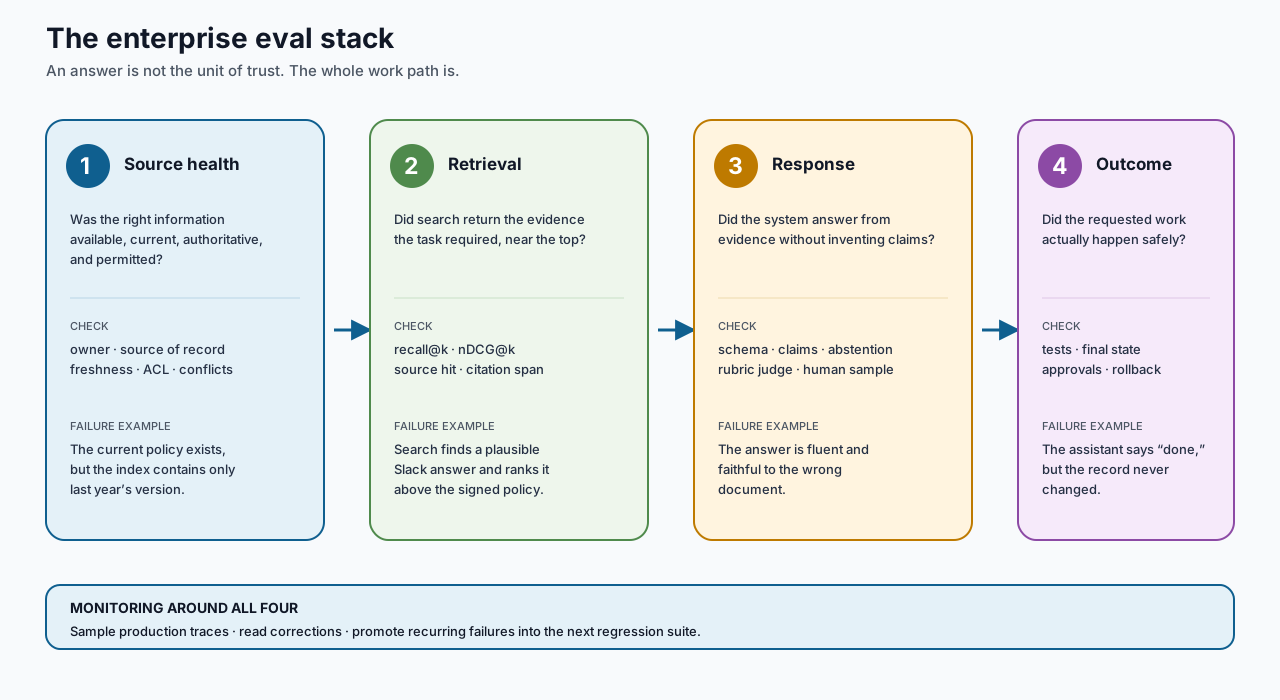
The ELI5 version: an AI answer is trustworthy only when the source, the search, the answer, and the resulting work all check out.
ELI5: an AI assistant is an intern with a search box
Imagine an intern answering an HR policy question and then updating a record.
The intern can fail in five different ways:
- The policy was missing, stale, or outside the intern’s permissions.
- The policy existed, but the intern searched the wrong place.
- The intern found the right policy but misunderstood it.
- The intern answered confidently but did not complete the requested task.
- The intern completed the task but changed the wrong record or exposed restricted information.
Calling all five failures “the model was inaccurate” sends the repair to the wrong team. Enterprise evals exist to identify which failure happened.
The current best strategy
Use four evaluation layers, with operations around all four:
| Layer | Plain-English question | Strong checks | Typical owner |
|---|---|---|---|
| Source health | Was the right information available, current, authoritative, and permitted? | Source-of-record status, owner, freshness, ACL, supersession, conflict state | Knowledge / records owner |
| Retrieval | Did search return the evidence the task required, near the top? | Recall@k, nDCG@k, source-hit rate, citation-span accuracy, stale-source penalty | Search / knowledge platform |
| Response | Did the system answer from the evidence without inventing claims? | Schema checks, claim support, abstention, rubric judge, human calibration | Product + domain SME |
| Outcome | Did the requested work actually happen safely? | Tests, database state, document diff, approval record, tool-call validity, rollback check | Workflow / agent owner |
| Operations | Does the system stay reliable as users, sources, models, and tools change? | Trace sampling, correction review, capability suite, regression suite, A/B test, cost and latency | Platform + product |
Anthropic’s January 2026 agent-evals guidance uses the same useful vocabulary: task, trial, grader, transcript, outcome, harness, and suite. It recommends multiple trials for stochastic agents, separate capability and regression suites, production monitoring, and periodic human calibration. No single layer catches every failure. (Anthropic, 2026)
AWS’s 2026 AgentCore Evaluations release makes the operating loop explicit: online evaluation samples production traces; on-demand evaluation supports CI/CD; ground truth can include reference answers, behavioral assertions, and expected tool sequences; custom code evaluators can run beside model judges. (AWS AgentCore Evaluations, 2026)
What changed in the last year
The field has moved from “pick a metric” toward “build a testable environment.” Four developments matter.
1. Ragas is now an experiment layer, not just a metric call
RAGAS separated retrieval and generation questions in its 2023 paper. That remains useful: a pipeline can retrieve the wrong context, retrieve too little context, or generate an unsupported answer. (RAGAS paper, 2023)
The current Ragas v0.4 documentation shifts from isolated evaluate() calls to experiment-based runs with structured results, collections-based metrics, provider support, and versioned iteration. That is the right direction for an enterprise eval loop. It does not make Ragas the enterprise source of truth. (Ragas v0.4 migration guide, retrieved August 1, 2026)
2. DeepEval has become an agent and trace harness
DeepEval’s current documentation covers RAG, agents, tool use, MCP, safety, multimodal cases, end-to-end tests, component-level traces, and CI/CD. Its 2026 releases added agent-native patch → eval → retry workflows, local trace inspection, source-aware retrieval context, deterministic loop detection, and a deterministic tool-permission metric. (DeepEval documentation, retrieved August 1, 2026; DeepEval releases, 2026)
The practical interpretation is narrow: use DeepEval or Ragas to accelerate test authoring, tracing, and diagnostics. Keep the firm’s task, source bundle, permission boundary, verifier, and normalized result row independent of the framework.
3. RipplingBench tests business work instead of model trivia
RipplingBench is the strongest new corporate example in this review. Rippling’s July 2026 private benchmark compares 15 model variants across roughly 2,100 scored runs per model using non-synthetic company data and workflows. The suite includes read-only analysis and state-changing tasks such as salary updates, onboarding, terminations, approvals, automations, and pay-run edits. A run passes only when production correctness checks pass; a run that never finishes fails. It reports pass rate, inference time, and actual dollar cost. (Matt MacInnis, “RipplingBench,” July 29, 2026)
Rippling also states the boundary clearly. The suite is Rippling-shaped, private, and not a general intelligence ranking. Its prompts and tools were tuned around Opus 4.6 for five months, so the other models are closer to floors than ceilings. That is a strength for honest interpretation, not a defect to hide.
Enterprise application: copy the design pattern, not the data. For each high-value workflow, create real or safely replayed tasks, an initial state, a permission boundary, executable correctness checks, and cost/latency capture. Never compare models on final text alone when the product changes records, money, access, or approvals.
4. Benchmark quality is now part of the eval
OpenAI’s July 2026 audit of SWE-bench Pro estimates that roughly 30% of the tasks examined were broken and retracts its earlier recommendation to adopt the benchmark. The audit used automated filtering, agent-assisted review, and human annotation. The lesson generalizes: a failed task may reflect the model, the harness, the prompt, the hidden test, or the benchmark itself. (OpenAI, “Separating signal from noise in coding evaluations,” July 8, 2026)
OpenAI’s 2026 third-party-evaluation playbook adds the fields a serious report should disclose: the claim, task content, tested system, budget, elicitation method, and validity checks for reward hacking, contamination, evaluation awareness, refusals, and sandbagging. (OpenAI, “A shared playbook for trustworthy third party evaluations,” 2026)
RAG: the metric is not the truth
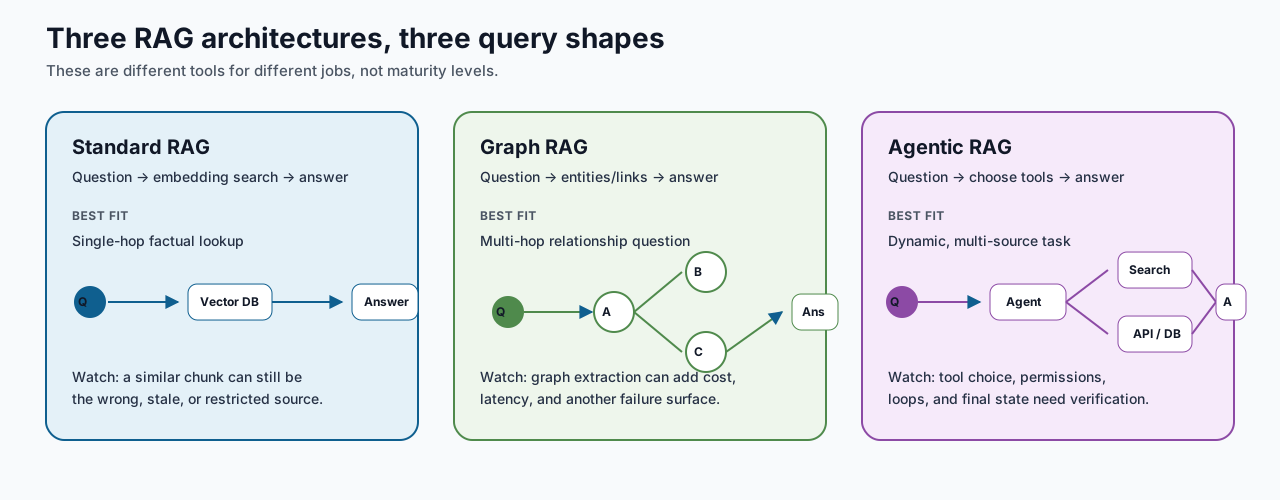
This is an original State of AI redraw of the architecture distinction. The animated originals are worth viewing: Akshay Pachaar’s RAG vs. Graph RAG vs. Agentic RAG diagram and Tech with Mak’s seven-architecture diagram, credited to Robbert van Vlijmen. The source posts are teaching diagrams, not independent benchmark evidence.
The architecture choice should follow the query shape:
| Query shape | Likely fit | Eval emphasis |
|---|---|---|
| Single-hop factual lookup | Standard RAG | source hit, rank, citation span, grounded answer |
| Multi-hop relationship query | Graph RAG | entity/relationship coverage, path correctness, graph freshness |
| Dynamic multi-source task | Agentic RAG | tool choice, permissions, loop control, final state, cost |
The boundary is decisive: an answer can be faithful to the wrong document. RAGAS faithfulness and RAGChecker’s fine-grained diagnostics evaluate support relative to retrieved context. They do not, by themselves, prove that the source is authoritative, current, permitted, or the right source of record. RAGChecker’s 2024 preprint reports a meta-evaluation across eight RAG systems; it is a diagnostic foundation, not a firmwide release standard. (RAGChecker, 2024)
Recent survey work makes the same problem broader: RAG evaluation must account for retrieval, generation, safety, efficiency, dynamic knowledge, and the limits of LLM judges. (Gan et al., “Retrieval Augmented Generation Evaluation in the Era of Large Language Models,” 2025; “Can LLMs Be Trusted for Evaluating RAG Systems?” 2025)
For finance and other exact-number domains, the retrieval baseline can reverse the usual assumption. The 2026 T²-RAGBench study evaluates 23,088 questions over 7,318 financial text-and-table documents and reports BM25 outperforming dense retrieval on most measures, while hybrid retrieval plus reranking performs best. Treat that as a domain-specific control, not a universal RAG law. (T²-RAGBench, 2026; State of AI financial RAG synthesis)
Public retrieval benchmarks such as BEIR, now commonly accessed through MTEB retrieval tracks, remain useful for shortlist calibration. They do not contain the firm’s private permissions, stale documents, source hierarchy, or conflict cases. (BEIR, 2021)
The verifier layer: the missing enterprise primitive
The current Prime Intellect Verifiers repository is a useful software pattern for enterprise evals. A taskset defines the work and immutable task data. A task runs in a harness and environment. A reward function or judge scores the trace. The system preserves traces.jsonl, the run configuration, logs, artifacts, rollout count, and runtime controls. The repository supports deterministic reward functions, LLM judges, toolsets, multi-agent environments, sandbox/network policies, artifact collection, multiple rollouts, and resumable evaluations. (Prime Intellect Verifiers repository, retrieved August 1, 2026; taskset docs; evaluation docs)
The enterprise translation is straightforward:
| Verifiers primitive | Enterprise equivalent |
|---|---|
| Taskset | Versioned workflow suite: HR policy, finance report, code change, support resolution |
| Task data | Private prompt, source snapshot, initial database state, user persona, permission boundary |
| Harness | The actual agent scaffold, tools, memory, model, retry policy, and router |
| Reward / verifier | Code checks for schema, citations, ACLs, tool calls, database state, approvals, and rollback |
| Trace | Full messages, retrieval, tool calls, observations, retries, and intermediate artifacts |
| Environment | Isolated replay database, repository snapshot, browser, API sandbox, or document store |
| Rollouts | Repeated trials for stochastic agents; report pass@1 and pass@k only with the trial policy |
| Artifacts | Diff, SQL, report, ticket, approval event, source bundle, test log, and final state |
Do not import RL reward thinking without its safety lessons. VerifyBench reports that verifier performance is sensitive to input structure and has limited cross-domain generalization. The LLMs Gaming Verifiers work shows how a system can satisfy an imperfect checker while missing the intended rule. (VerifyBench, AAAI 2026; LLMs Gaming Verifiers repository, 2026)
For an enterprise-wide sweep, every verifier needs its own test pack:
- Positive examples that should pass.
- Negative examples that should fail.
- Boundary cases with ambiguity, missing data, and conflicting sources.
- Permission cases where the model must abstain or refuse.
- Hidden or held-out cases that prevent overfitting to the checker.
- Metamorphic cases where irrelevant wording changes must not change the decision.
- Human-reviewed cases for semantic quality that code cannot settle.
The verifier is not a judge of everything. It is a narrow contract for one observable property. That is why narrow graders, explicit evidence, and several independent checks outperform one composite score.
The release gate
Do not ship because one score went up. Use a hybrid gate:
| Gate | Rule |
|---|---|
| Security and permissions | Hard fail on unauthorized retrieval, citation, tool use, or side effect |
| Deterministic correctness | Hard fail when code, JSON, calculations, schemas, tests, or final state are wrong |
| Evidence quality | Hard fail when a high-risk task cites stale, superseded, or non-authoritative evidence |
| Task utility | Require the target persona to receive a useful answer or completed work product |
| Judge score | Use calibrated model graders for nuance such as completeness, tone, and escalation |
| Human review | Review a stratified sample plus all borderline or high-risk cases |
| Regression | Do not regress on capabilities already accepted into the production contract |
| Operations | Compare latency, cost, timeout rate, and correction burden against the incumbent |
OpenAI’s current eval guidance still describes the core loop as define the task, run inputs, inspect results, and iterate. The enterprise addition is to preserve the evidence and outcome needed to explain the score later. (OpenAI evals documentation, retrieved August 1, 2026)
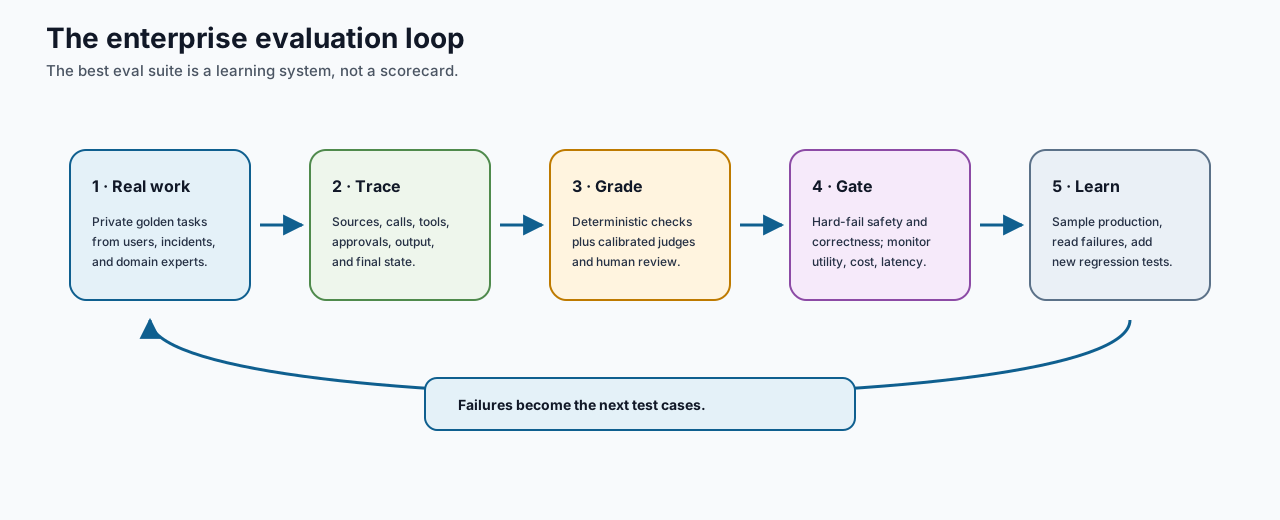
What belongs in one enterprise test case
The durable unit is a golden work packet, not a prompt.
persona: hr_business_partner
task: answer_policy_question_and_cite_source
source_bundle: policy_snapshot_2026_08_01
initial_state: employee_record_fixture_v3
permission_boundary: employee_policy_only
expected_output: answer_with_citation_or_abstention
deterministic_checks:
  - citation_points_to_source_span
  - answer_schema_valid
  - no_restricted_source_used
  - final_state_matches_expected
rubric:
  - policy_correctness
  - completeness
  - appropriate_escalation
trace_requirements:
  - retrieved_documents
  - tool_calls
  - approvals
  - artifacts
  - final_state
This lets a firm run Ragas, RAGChecker, DeepEval, Promptfoo, OpenAI Evals, Verifiers, or a custom runner without letting any vendor’s output format become the enterprise source of truth. Keep the native artifact for diagnosis; normalize the result row for firmwide reporting. (State of AI schema crosswalk)
How this updates the State of AI eval corpus
The State of AI field guide’s June 2026 ingestion records 318 cited rows, 318 golden exemplars, 269 raw mirrors, 143 mirrored BenchFlow notes, and 83 Chandra-extracted PDF rows. That corpus is a discovery and design asset, not a reason to cite every source in a quick hitter. The public article should use a selected primary-source ledger and point back to the deeper notes. (State of AI Evals Field Guide)
| Existing State of AI lane | Update now required |
|---|---|
| RAG and retrieval articles | Split source health, retrieval, response, and outcome. Add the cited RAG architecture visual. Keep lexical, hybrid, and reranking controls for exact-number domains. |
| Agent and coding benchmarks | Add executable final-state checks, trace retention, harness version, and benchmark QA. Do not treat pass@1 or a public leaderboard as deployment proof. |
| Eval-framework comparisons | Compare task, evidence, trace, verifier, judge, artifact, and result-row contracts. Preserve native formats and export late. |
| Corporate eval case studies | Separate company-reported practice from independent effectiveness. Record what the company tested, what it did not test, and where the harness was tuned. |
| Model-release comparisons | Run the same private work packets against the incumbent and candidate. Report cost, latency, failure class, and correction burden beside pass rate. |
| Finance RAG and agent notes | Keep BM25/hybrid/rerank baselines, table-aware checks, numerical exactness, and source-time validity as first-class controls. |
The cross-project session review found prior eval work and schema discussions, but the archive reported incomplete semantic coverage and one quarantined conversation. The corpus crosswalk above is therefore a verified local inventory, not a claim that every prior session has been recovered.
The minimum viable enterprise program
Start with one mission-critical workflow and build this in order:
- Collect 30–50 real tasks from production, support, incidents, or domain SMEs. Treat that as a starting heuristic, not a universal sample-size rule.
- Add missing-source, stale-source, conflicting-source, permission-restricted, adversarial, and “should abstain” cases.
- Freeze the source snapshot, prompt version, model version, retrieval index, tool catalog, harness, and judge rubric.
- Run deterministic checks before model judges.
- Test the verifier itself with positive, negative, held-out, and metamorphic cases.
- Calibrate judges against human labels, then send borderline cases to humans.
- Run multiple trials for stochastic agents and preserve the full trace.
- Separate capability tests from regression tests.
- Sample production, read failures, and turn each recurring failure into a new test.
- Compare the candidate to the incumbent on pass rate, cost, latency, timeout rate, and correction burden.
Airbnb’s eval-driven-development account adds a practical discipline: inspect real outputs and traces before inventing metrics, keep evaluators narrow, calibrate them, and change one experimental variable at a time. (Airbnb Engineering, retrieved August 1, 2026)
What this means for your organization
The first firmwide deliverable should be a versioned work-packet and verifier registry, not a dashboard. Each workflow owner supplies private tasks, source and permission fixtures, final-state checks, and a named reviewer. A central platform team supplies the runner, trace schema, artifact retention, judge calibration, and release report.
The executive decision is not “which model won?” It is “which system completes this work safely, at what cost, under which evidence contract, and with what correction burden?” That is the comparison RipplingBench makes possible and the public benchmark ecosystem cannot make for you.
If this raised questions specific to your organization, I’d welcome the conversation — brandon@brandonsneider.com
Evidence Boundaries
- A public benchmark does not prove private workflow readiness.
- RAG faithfulness does not prove source authority, freshness, or permission compliance.
- A company blog or X article can reveal a useful test design without proving independent effectiveness.
- An LLM judge is not objective without calibration, disagreement review, and judge-drift monitoring.
- A verifier can be gamed unless it tests invariants, negative cases, hidden cases, and metamorphic variants.
- A single pass rate hides cost, latency, timeout, safety, and correction-burden tradeoffs.
- The recommendation is a firmwide architecture pattern. Thresholds must be set by workflow risk and owner, not copied from another company.
Sources
- Anthropic. “Demystifying evals for AI agents.” January 9, 2026. https://www.anthropic.com/engineering/demystifying-evals-for-ai-agents. Vendor practitioner evidence; high value for agent-eval structure, not independent effectiveness proof.
- AWS. “Amazon Bedrock AgentCore Evaluations is now generally available.” March 31, 2026. https://aws.amazon.com/about-aws/whats-new/2026/03/agentcore-evaluations-generally-available/. Product documentation; implementation evidence for online, CI, code-based, and model-based evaluators.
- AWS. “Amazon Bedrock AgentCore introduces new optimization capabilities.” June 17, 2026. https://aws.amazon.com/about-aws/whats-new/2026/06/amazon-bedrock-agentcore-new-optimization-capabilities/. Product documentation; implementation evidence for failure clustering, batch eval, and A/B validation.
- AWS. “AWS announces aws-bench.” July 24, 2026. https://aws.amazon.com/about-aws/whats-new/2026/07/aws-bench/. Corporate benchmark announcement; useful public calibration pattern, not private enterprise proof.
- OpenAI. “Separating signal from noise in coding evaluations.” July 8, 2026. https://openai.com/index/separating-signal-from-noise-coding-evaluations/. Primary benchmark-quality audit; supports benchmark QA and human/agent review triangulation.
- OpenAI. “A shared playbook for trustworthy third party evaluations.” 2026. https://openai.com/index/trustworthy-third-party-evaluations-foundations/. Primary guidance; supports disclosure of claim, system, budget, elicitation, and validity checks.
- OpenAI. “Working with evals.” Retrieved August 1, 2026. https://developers.openai.com/api/docs/guides/evals. Official implementation guidance; task, grader, and iteration contract.
- MacInnis, Matt. “RipplingBench: A comparison of open-weight and frontier models in real-world use cases.” July 29, 2026. https://x.com/stanine/status/2082633533680415159?s=46. Company-authored private benchmark; high-value test-design evidence, not independent or model-neutral ranking.
- Prime Intellect.
verifiersrepository and v1 documentation. Retrieved August 1, 2026. https://github.com/PrimeIntellect-ai/verifiers. Source/code and docs verified; useful primitive pattern for tasksets, traces, verifiers, environments, artifacts, and rollouts. - Ragas. “Migration from v0.3 to v0.4.” Retrieved August 1, 2026. https://docs.ragas.io/en/latest/howtos/migrations/migrate_from_v03_to_v04/. Current project documentation; experiment architecture and structured results.
- Confident AI. DeepEval documentation and releases. Retrieved August 1, 2026. https://deepeval.com/docs/introduction; https://github.com/confident-ai/deepeval/releases. Current project documentation and release artifacts; agent, trace, RAG, tool, and CI primitives.
- Es, Shahul, et al. “RAGAS: Automated Evaluation of Retrieval Augmented Generation.” September 26, 2023. https://arxiv.org/abs/2309.15217. Foundational preprint; older model generation and insufficient for source authority.
- Ru, Dongyu, et al. “RAGChecker: A Fine-grained Framework for Diagnosing Retrieval-Augmented Generation.” 2024. https://arxiv.org/abs/2408.08067. Preprint; diagnostic framework and eight-system meta-evaluation.
- Gan, Aoran, et al. “Retrieval Augmented Generation Evaluation in the Era of Large Language Models.” April 21, 2025. https://arxiv.org/abs/2504.14891. Survey; current taxonomy and limitations, not an enterprise release gate.
- “Can LLMs Be Trusted for Evaluating RAG Systems? A Survey of Methods and Datasets.” April 28, 2025. https://arxiv.org/abs/2504.20119. Survey; supports judge-calibration boundary.
- Thakur et al. “BEIR.” 2021. https://arxiv.org/abs/2104.08663. Historical public retrieval calibration; not private enterprise deployment evidence.
- Akarso, Karaman, and Mierbach. “From BM25 to Corrective RAG: Benchmarking Retrieval Strategies for Text-and-Table Documents.” 2026. https://arxiv.org/abs/2604.01733. Domain-specific retrieval benchmark over 23,088 questions and 7,318 financial documents; do not generalize beyond its corpus.
- Akshay Pachaar. “RAG vs. Graph RAG vs. Agentic RAG.” July 2, 2026. https://x.com/akshay_pachaar/status/2072767459908796782/photo/1. Teaching diagram; original State of AI visual is a credited redraw.
- Tech with Mak, crediting Robbert van Vlijmen. “Seven RAG architectures.” July 28, 2026. https://x.com/techNmak/status/2082173681862889885/photo/1. Teaching diagram; original State of AI visual is a credited redraw.
- VerifyBench. “A Systematic Benchmark for Evaluating Reasoning Verifiers Across Domains.” AAAI 2026. https://ojs.aaai.org/index.php/AAAI/article/view/40448. Primary verifier research; supports input-structure and cross-domain limitations.
- ML Research.
llms-gaming-verifiersrepository. 2026. https://github.com/ml-research/llms-gaming-verifiers. Code/research artifact; supports reward-hacking boundary. - State of AI. “Enterprise AI Evals Field Guide — 2026.” June 24, 2026. https://stateofai.pages.dev/technical/21-benchmarks/enterprise-ai-evals-field-guide-2026/. Internal corpus synthesis; used for cross-project coverage and schema boundaries.
- State of AI. “Enterprise Evaluation for Knowledge Bases and Coding Agents — 2026.” https://stateofai.pages.dev/technical/21-benchmarks/enterprise-evaluation-knowledge-coding-agents-2026/. Internal synthesis; golden work packets, trace requirements, and ownership boundaries.
- State of AI. “Eval Framework Schema Crosswalk.” https://stateofai.pages.dev/technical/21-benchmarks/eval-framework-schema-crosswalk-2026/. Internal synthesis; native artifact and normalized result-row boundary.
- State of AI. “Financial RAG: Hybrid+Rerank…” https://stateofai.pages.dev/technical/21-benchmarks/financial-text-table-rag-2026/. Internal domain synthesis; exact-number and table-aware retrieval control.
State of AI | brandon@brandonsneider.com August 2026